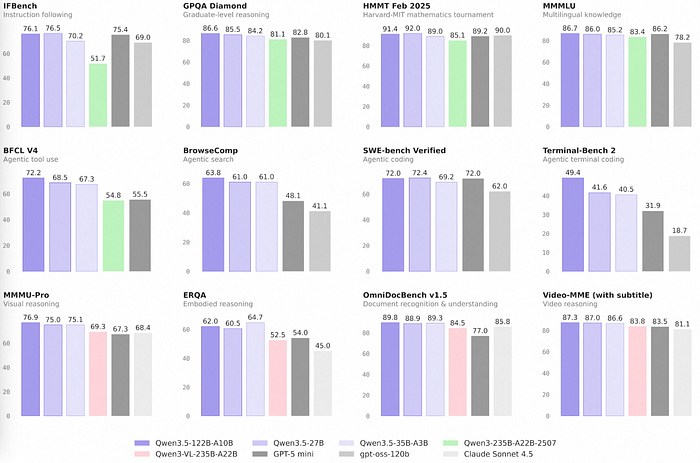


Qwen3.5–27B-Claude-4.6-Opus-Reasoning-Distilled, Qwopus for short, takes the Qwen 3.5 27B base model and fine-tunes it specifically on Claude Opus 4.6 reasoning chains. The goal: take a fast, efficient local model and teach it how Claude thinks through hard problems.
Not how Claude answers. How does it reason before answering?
What "Reasoning Distillation" Actually Means
When Claude Opus 4.6 works through a complex problem, it doesn't just output an answer. It builds a structured internal monologue first — breaking the problem down, identifying constraints, planning steps, checking consistency. That process lives inside <think> tags and never shows up in the final response unless you look for it.
Distillation means capturing that process and training a smaller model to imitate it. Not the answers Claude gives. The reasoning scaffolding Claude uses to get there.
Qwopus was trained specifically on three datasets of Claude Opus reasoning trajectories:
DatasetPurposenohurry/Opus-4.6-Reasoning-3000x-filteredFull Claude 4.6 Opus reasoning chainsTeichAI/claude-4.5-opus-high-reasoning-250xHigh-intensity structured reasoningJackrong/Qwen3.5-reasoning-700xStep-by-step problem solving diversity
The training pipeline is straightforward:
Base Model (Qwen3.5-27B)
 │
 ▼
Supervised Fine-Tuning (SFT) + LoRA
 │
 ▼
Final Model (Claude-4.6-Opus-Reasoning-Distilled, text-only)
One detail worth noting: training used train_on_responses_only, which masks the instruction side. The model only learns from the generation of <think> sequences and the final answers. Not from the prompts. This keeps the training signal clean — the model learns reasoning structure, not prompt pattern-matching.
Every training sample was normalized to enforce a strict output format:
<think> {internal reasoning} </think>
{final answer}
The Reasoning Pattern It Learned
Base Qwen 3.5 has a known tendency toward repetitive, circular reasoning on simple queries. It second-guesses itself, loops back, restates the same point in different words. Fine for hard problems. Wasteful on straightforward ones.
Qwopus addresses this by distilling Claude Opus's more structured approach. Instead of exploratory trial-and-error, the think block follows a consistent pattern:
Let me analyze this request carefully:

1. Identify the core objective of the problem.
2. Break the task into clearly defined subcomponents.
3. Evaluate constraints and edge cases.
4. Formulate a step-by-step solution plan.
5. Execute the reasoning sequentially and verify consistency.
That's not a prompt template. That's what the model actually generates internally before producing a response. Confident parsing upfront. Outlined plan in the think block. Sequential execution rather than backtracking.
The practical result: fewer redundant reasoning loops, faster time to answer on simple queries, and preserved deep analytical capacity on hard ones.
Why It Matters for Local Coding Agents
This is where Qwopus earns its place over vanilla Qwen 3.5 27B.
Every modern coding agent — OpenCode, Claude Code, anything built for software development — sends a developer role in its messages. Base Qwen 3.5's chat template doesn't recognize it. The template hits raise_exception('Unexpected message role.') and your server returns 500s in a loop before a single token generates.
The common workaround is --chat-template chatml. It stops the crash but silently disables thinking mode. Server logs show thinking = 0. No think blocks. No chain of thought. You're running a reasoning model without the reasoning.
Qwopus doesn't have this problem. It natively handles the developer role. No Jinja template patches. No ChatML workarounds. Logs confirm thinking = 1 on startup and it stays there.
Beyond the template fix, community testing by @sudoingX on a single RTX 3090 showed something more interesting: Qwopus ran autonomously for over 9 minutes without human intervention during coding tasks. It waited for tool responses, read outputs, self-corrected errors, and even generated a README automatically. The base model stalls or freezes mid-execution in the same scenarios.
That's the reasoning distillation doing its job. A model that knows how to plan and verify its own steps handles agentic loops better than one that pattern-matches and hopes.
Hardware Requirements
This is a 27B model. The numbers:
- VRAM: ~16.5 GB with Q4_K_M quantization
- Speed: 29–35 tok/s
- Context: Full 262K — no compromise
Fits on a single RTX 3090. No dual-GPU setup. No CPU offload degrading your speed.
The command to run it:
llama-server -m Qwen3.5-27B-Claude-4.6-Opus-Reasoning-Distilled-Q4_K_M.gguf \
  -ngl 99 \
  -c 262144 \
  -fa on \
  --cache-type-k q4_0 \
  --cache-type-v q4_0
No --chat-template flag needed. No patched Jinja file. Just load and run.
Weights: https://huggingface.co/Jackrong/Qwen3.5-27B-Claude-4.6-Opus-Reasoning-Distilled-GGUF
What It's Good For
The intended use cases are analytical rather than general:
- Coding — especially with agentic tools where multi-step reasoning matters
- Math — structured breakdown of complex problems
- Logic-heavy tasks — anything where you want to see the reasoning, not just the answer
- Offline analytical work — the transparent
<think>block lets you follow the model's internal logic
What it's not designed for: real-time factual retrieval or tasks requiring verified external knowledge. It's still an autoregressive LLM. The reasoning is structured but not grounded — facts generated during the think sequence can hallucinate just like any other output.
One Honest Caveat
The model page calls this a preview build and means it. The reasoning quality is solid. The hardware efficiency is real. The coding agent compatibility is a genuine improvement over base Qwen.
But the surrounding ecosystem — inference templates, fine-tuning pipelines, tooling integrations — is still catching up. You might hit edge cases. Compatibility quirks with less common setups are possible.