
Best Learning Approach
Theory → Code → Project → Interview Questions → Real Scenarios If you want to become a strong Java Spring Boot Microservices Developer, do not learn only theory.
If you're not a Medium subscriber, you can read the full interview-focused article using this friend's link: 👉 Read the full article here
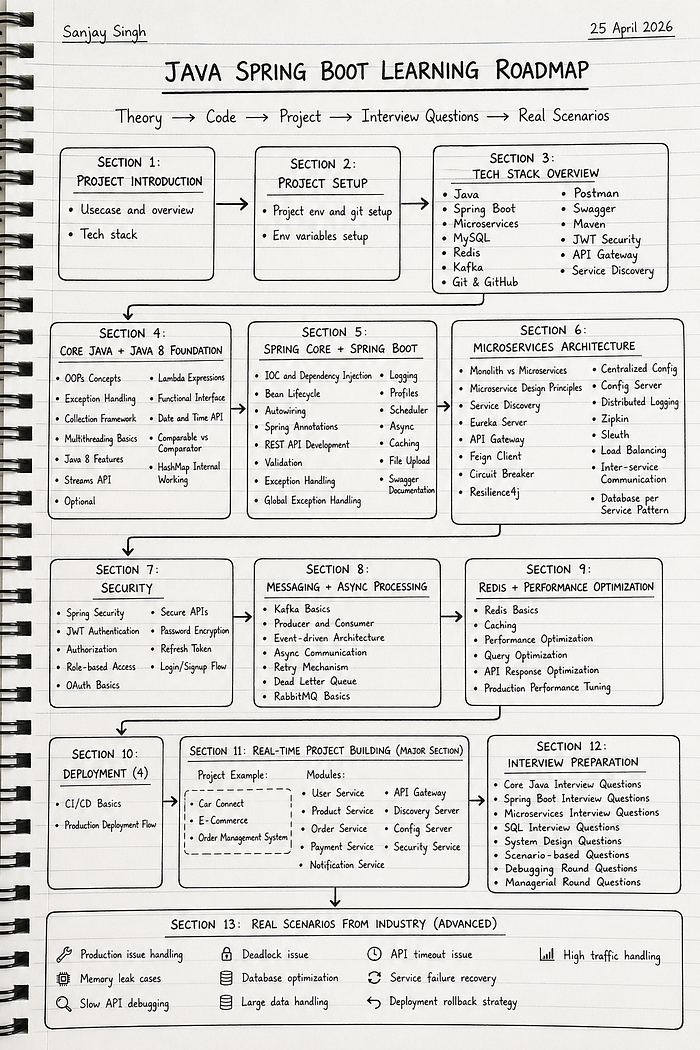
The best approach is:
- Understand the concept
- Write code practically
- Build real projects
- Prepare interview questions
- Solve production-level real scenarios
This roadmap is designed for students, working professionals, and developers who want to become interview-ready as well as industry-ready.
Section 1: Project Introduction
Topics
- Usecase and Overview
- Tech Stack Understanding
Goal
Before writing code, understand why the project exists and how real companies design applications.
Section 2: Project Setup
Topics
- Project Environment Setup
- Git Setup
- Environment Variables Setup
Goal
Create a strong foundation for clean development and team collaboration.
Section 3: Tech Stack Overview
Topics
- Java
- Spring Boot
- Microservices
- MySQL
- Redis
- Kafka
- Git & GitHub
- Postman
- Swagger
- Maven
- JWT Security
- API Gateway
- Service Discovery
Goal
Understand how every tool works together inside a production system.
Section 4: Core Java + Java 8 Foundation
Topics
- OOPs Concepts
- Exception Handling
- Collection Framework
- Multithreading Basics
- Java 8 Features
- Streams API
- Optional
- Lambda Expressions
- Functional Interface
- Date and Time API
- Comparable vs Comparator
- HashMap Internal Working
Goal
Strong Java foundation is mandatory before Spring Boot.
Section 5: Spring Core + Spring Boot
Topics
- IOC and Dependency Injection
- Bean Lifecycle
- Autowiring
- Spring Annotations
- REST API Development
- Validation
- Exception Handling
- Global Exception Handling
- Logging
- Profiles
- Scheduler
- Async
- Caching
- File Upload
- Swagger Documentation
Goal
Learn how enterprise-grade backend systems are built.
Section 6: Microservices Architecture
Topics
- Monolith vs Microservices
- Microservice Design Principles
- Service Discovery
- Eureka Server
- API Gateway
- Feign Client
- Circuit Breaker
- Resilience4j
- Centralized Config
- Config Server
- Distributed Logging
- Zipkin
- Sleuth
- Load Balancing
- Inter-service Communication
- Database per Service Pattern
Goal
Understand how large-scale systems work in real companies.
Section 7: Security
Topics
- Spring Security
- JWT Authentication
- Authorization
- Role-based Access
- OAuth Basics
- Secure APIs
- Password Encryption
- Refresh Token
- Login/Signup Flow
Goal
Security is not optional — it is mandatory in production systems.
Section 8: Messaging + Async Processing
Topics
- Kafka Basics
- Producer and Consumer
- Event-driven Architecture
- Async Communication
- Retry Mechanism
- Dead Letter Queue
- RabbitMQ Basics
Goal
Learn how modern scalable systems handle background processing.
Section 9: Redis + Performance Optimization
Topics
- Redis Basics
- Caching
- Performance Optimization
- Query Optimization
- API Response Optimization
- Production Performance Tuning
Goal
Performance optimization separates junior developers from senior developers.
Section 10: Deployment
Topics
- CI/CD Basics
- Production Deployment Flow
Goal
Learn how code reaches production safely.
Section 11: Real-Time Project Building (Major Section)
Project Examples
- Car Connect
- E-Commerce
- Order Management System
Modules
- User Service
- Product Service
- Order Service
- Payment Service
- Notification Service
- API Gateway
- Discovery Server
- Config Server
- Security Service
Goal
This is the most important section because projects create confidence and interview strength.
Section 12: Interview Preparation
Topics
- Core Java Interview Questions
- Spring Boot Interview Questions
- Microservices Interview Questions
- SQL Interview Questions
- System Design Questions
- Scenario-based Questions
- Debugging Round Questions
- Managerial Round Questions
Goalc
Prepare for both technical rounds and leadership rounds.
Section 13: Real Scenarios from Industry (Advanced)
Topics
- Production Issue Handling
- Memory Leak Cases
- Slow API Debugging
- Deadlock Issue
- Database Optimization
- Large Data Handling
- API Timeout Issue
- Service Failure Recovery
- Deployment Rollback Strategy
- High Traffic Handling
Goal
This section makes you think like a real software engineer.
Final Advice
Do not try to finish everything fast.
Focus on:
Consistency > Speed
Learn deeply. Build practically. Think like an architect. Debug like a senior engineer.